Select Page

Speech ♥ Drama ♥ EQ

Phonics and Reading Programme
N2, K1 & K2

Building Strong Readers from Preschool to Primary 1

Our Phonics & Reading Programme for preschoolers in Singapore provides a progressive learning pathway for children from N2 to K2, carefully developing the phonics, spelling and reading skills required at each stage of their preschool journey.

Rather than teaching phonics as an isolated skill, we help children understand how sounds and letters come together to form words, sentences and eventually meaningful stories.

Our programme grows with your child:

N2: Sounds → Letters → Early Blending

Build strong phonological awareness, recognise letter-sound relationships and begin blending simple words with confidence.

K1: Blending → Decoding → Early Reading

Apply phonics knowledge to decode unfamiliar words, recognise common sight words and progress into reading short sentences and simple stories.

K2: Fluency → Reading Comprehension → Primary 1 Readiness

Read longer texts with greater accuracy, expression and independence while developing vocabulary, comprehension, sequencing and simple inferencing skills needed for Primary School English.

The ultimate goal is simple: To develop children who can read and who feel confident enough to read independently.

More Than a Phonics Class

Parents searching for a phonics class in Singapore will often find programmes that focus heavily on recognising letter sounds.

A child may know that:

c says /c/
a says /a/
t says /t/

but still struggle to blend the sounds together to read: cat

Another child may successfully sound out every word on a page but finish reading with very little understanding of what the story was about.

That is why our programme combines phonics and reading. Children develop not only the ability to decode words, but gradually learn to:

  • recognise sounds within words
  • connect letters with their sounds
  • blend sounds together
  • segment words for spelling
  • recognise common sight words
  • identify familiar spelling patterns
  • decode unfamiliar words
  • read sentences accurately
  • develop reading fluency
  • read aloud with expression
  • build vocabulary
  • understand what they are reading
  • answer comprehension questions
  • talk about characters and events
  • sequence a story
  • make simple predictions and inferences
  • write words and sentences using their phonics knowledge
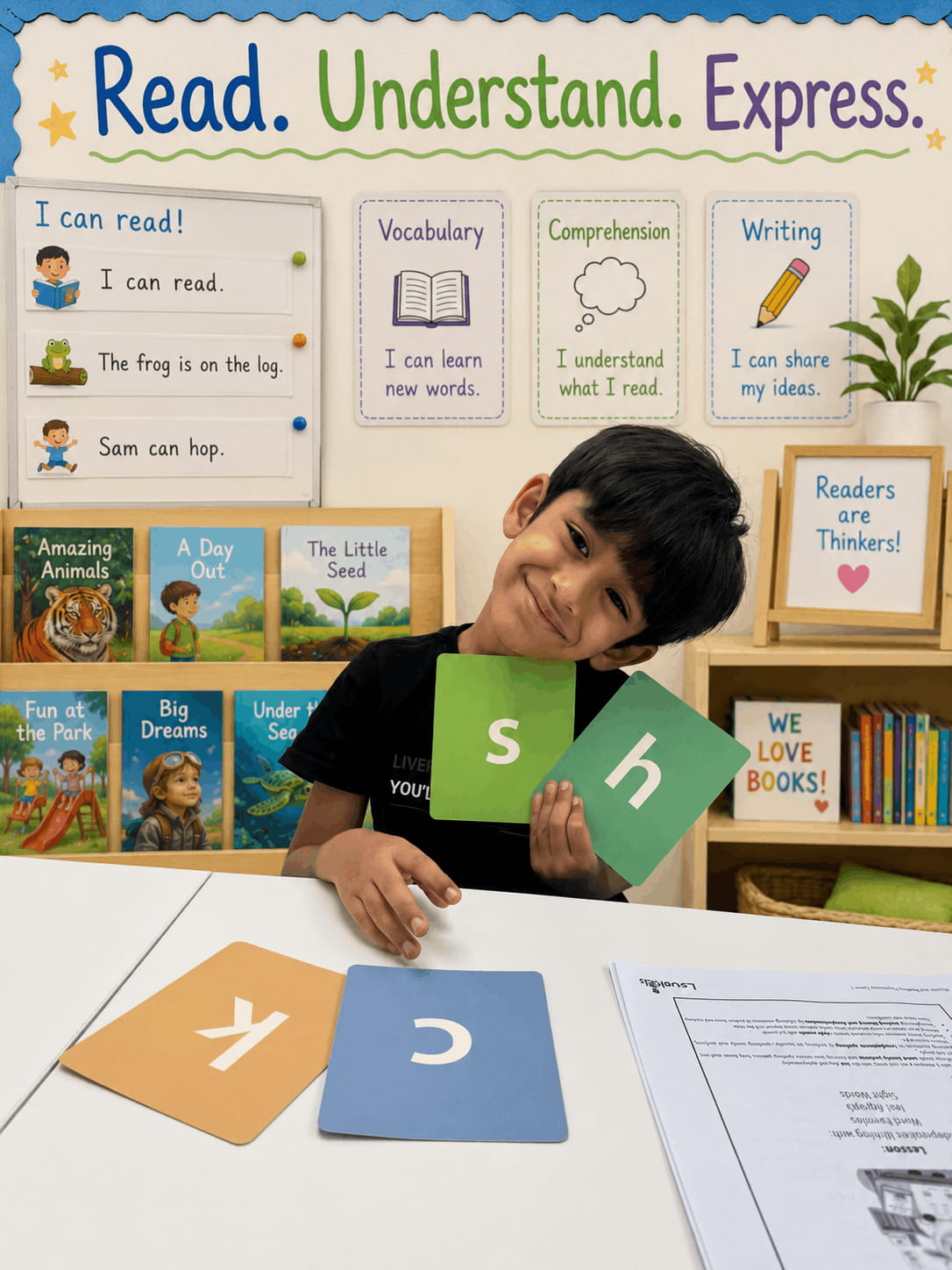
phonics and reading programme for N2 K1 and K2

In other words:

We do not teach children to simply “know phonics”. We teach them to use phonics to become confident readers!

phonics and reading programme for N2 K1 and K2

Why Are Phonics and Early Literacy Important Before Primary 1?

As children enter Primary 1 in Singapore, English learning increasingly requires them to read instructions, sentences, passages and questions with greater independence.

A child who has to use most of their effort simply working out individual words has less attention available to understand:

  • What does this sentence mean?
  • What is the question asking me?
  • What happened in the story?

Building stronger decoding and reading fluency during the preschool years can therefore give children more capacity to focus on meaning and comprehension as texts become longer.

Our aim is to build the foundational literacy skills children will eventually draw upon in Primary 1 English and beyond.

A Progressive Phonics & Reading Journey

Our N2, K1 and K2 Phonics and Reading Programme follows a progressive approach.

Click on the boxes below to learn more!

N2 Phonics & Reading

Building Early Literacy Foundations
Sounds → Letters → Early Blending

At the N2 level, the goal is not to rush children into reading long sentences. We first build the essential skills that successful reading depends upon. Young children need to develop an awareness that spoken words are made up of individual sounds and that those sounds can be represented by letters.

Our N2 phonics classes therefore focus strongly on phonological awareness, letter-sound recognition and reading readiness.

N2 Children Learn To:

1. Hear and Identify Sounds

Children develop greater awareness of the sounds within spoken language.

Activities may include:

  • identifying beginning sounds
  • recognising sounds that are the same or different
  • listening for sounds within simple words
  • rhyming activities
  • syllable awareness
  • sound discrimination

Before children can confidently work with written phonics, they need to become more aware of the sounds they hear.

2. Connect Sounds to Letters

Children gradually develop their understanding that letters represent sounds.

They learn to:

  • recognise letters
  • recall common letter sounds
  • associate sounds with their written symbols
  • identify letters within words
  • build early print awareness

We use multisensory activities, stories, movement and literacy activities to keep early phonics meaningful and engaging.

3. Begin Blending Simple Words

When children are developmentally ready, they begin learning that separate sounds can be pushed together to form a word.

For example:
c – a – t → cat
s – u – n → sun

This is an important transition.

The child is no longer simply memorising individual sounds — they are beginning to understand how reading works.

4. Develop Early Sight Word Awareness

Some frequently encountered words are introduced gradually so children begin recognising familiar words automatically within simple sentences and books.

5. Build Vocabulary Through Stories

Phonics should never exist separately from language. Children listen to and interact with stories, pictures and conversations that help them understand the meaning behind the words they are learning to read.

6. Develop Confidence Around Books

At N2, one of our biggest goals is creating a positive relationship with reading.

Children learn important early literacy behaviours such as:

  • following text from left to right
  • recognising that print carries meaning
  • listening to stories
  • answering simple questions
  • identifying characters and objects
  • joining in with repeated phrases
  • handling books appropriately

We want children to think, “Books are something I can understand and enjoy!”

N2 Milestones

By gradually building phonological awareness, letter-sound knowledge and early blending skills, children develop the foundations they will need for more structured decoding and reading in K1.

N2 Progression:

Listening to Sounds → Recognising Letters → Blending Simple Words → Reading Readiness

The goal is not speed.
The goal is a strong foundation.

K1 Phonics & Reading

From Knowing Sounds to Reading Words
Blending → Decoding → Early Reading

By K1, children are increasingly ready to apply their phonics knowledge to actual reading.

This is an important stage because some children know many letter sounds but have difficulty transferring that knowledge into fluent word reading.

Our K1 phonics and reading programme therefore places greater emphasis on blending, decoding, word recognition and early reading fluency.

K1 Children Learn To:

1. Blend and Decode Words

Children practise combining sounds smoothly to read increasingly varied words

Depending on their readiness, this may include:

  • CVC words
  • CVCC and CCVC words
  • common consonant blends
  • digraphs
  • familiar word families
  • increasingly complex phonics patterns

Rather than memorising entire lists of words, children develop strategies for working unfamiliar words out independently.

2. Segment Words for Spelling

Reading and spelling reinforce each other.

If a child hears:
ship
they begin learning to break the word into its individual sounds and recognise the letters or letter patterns needed to represent them.

This strengthens the relationship between:
decoding — reading a word
and
encoding — spelling a word.

3. Develop Sight Word Recognition

High-frequency words appear repeatedly in children’s reading. Building automatic recognition of commonly encountered words helps children move through sentences more smoothly rather than stopping to decode every single word.

4. Moving from Words to Sentences

K1 children gradually progress beyond isolated word reading.

They begin reading:
words → phrases → short sentences → simple stories
This transition is crucial because true reading is not simply identifying individual words. Children need to learn how words work together to communicate meaning.

5. Building Reading Fluency

A child may technically be able to decode:
The / dog / ran / to / the / park.
but reading each word separately can make understanding difficult.

K1 children therefore begin developing:

  • smoother blending
  • more automatic word recognition
  • appropriate pacing
  • awareness of punctuation
  • phrasing
  • reading aloud with expression

We gradually help children move from slow, effortful decoding towards more connected reading.

6. Understanding What They Read

As children become more confident readers, they also work on comprehension. K1 literacy activities may include:

  • identifying characters
  • identifying settings
  • sequencing events
  • answering who, what and where questions
  • predicting what might happen next
  • identifying simple problems and solutions
  • discussing character feelings
  • retelling important parts of a story

This teaches children an important lesson:
We read to understand — not simply to pronounce words correctly.

K1 Milestones

By the end of this developmental stage, our goal is for children to become increasingly capable of applying their phonics knowledge without relying on an adult to tell them every word

K1 Progression:

Blending Words → Decoding Unfamiliar Words → Reading Sentences → Understanding Simple Stories

The goal is for them to say, “I can try to read this myself!”

K2 Phonics & Reading

Developing Fluent, Confident Readers for Primary 1
Fluency → Comprehension → Independence

At K2, phonics does not disappear. Instead, children learn to apply their phonics knowledge more automatically and across increasingly challenging words and texts.

Our K2 Phonics & Reading Programme focuses on bridging the gap between learning to read and being able to use reading confidently as a learning tool.

This becomes increasingly important as children prepare for the transition from preschool to Primary 1.

K2 Children Learn:

1. How to Decode More Challenging Words

Children apply a wider range of phonics strategies when encountering unfamiliar words.

Depending on their level, they may work with:

  • digraphs
  • consonant blends
  • long and short vowel patterns
  • alternative sound patterns
  • word families
  • compound words
  • longer words
  • multisyllabic words

Children learn that when they meet an unfamiliar word, they do not immediately need someone to tell them the answer. Instead, they can:

look at it → break it down → apply what they know → try again.

This builds both reading ability and independence.

2. To Develop Reading Fluency

At this stage, our focus increasingly moves towards helping children read longer sentences and texts with:

  • greater accuracy
  • smoother pacing
  • appropriate pauses
  • phrasing
  • intonation
  • expression

Children learn to recognise punctuation cues and understand how their voice can communicate meaning.

Our goal is to move them beyond mechanical reading towards natural, meaningful reading aloud.

3. To Strengthen Reading Comprehension

Being able to pronounce every word correctly does not necessarily mean a child understands the passage.

K2 children therefore work increasingly on:

  • recalling important information
  • sequencing events
  • identifying characters and settings
  • identifying key ideas
  • understanding cause and effect
  • predicting outcomes
  • explaining character feelings
  • making simple inferences
  • connecting information across a story
  • answering questions about what they have read

These are important foundations for the reading comprehension skills children will continue developing in Primary School English.

4. Vocabulary Development

The stronger a child’s vocabulary becomes, the easier it is for them to understand what they read and express what they mean.

Our K2 literacy lessons therefore continue building vocabulary through:

  • stories
  • passages
  • discussions
  • contextual clues
  • new words and phrases
  • describing characters and events

Children are encouraged not only to recognise new vocabulary, but to understand and use it.

5. Connecting Reading and Writing

By K2, children increasingly see how reading, spelling and writing work together. Literacy activities may include:

  • spelling words using phonics strategies
  • sentence dictation
  • constructing complete sentences
  • applying sight words
  • sequencing written ideas
  • vocabulary application

This provides a meaningful bridge between early reading and the writing demands of Primary 1.

6. To Build Primary 1 Reading Readiness

Primary 1 readiness is about helping children develop the foundations that allow them to enter Primary 1 feeling. “I’ve got this!”

For reading, that means being able to draw upon strategies when they encounter unfamiliar words, longer sentences, instructions, short passages and comprehension questions. Rather than immediately feeling overwhelmed, we want children to know how to break a reading task into manageable steps.

K2 Milestones

Our goal is for K2 children to progress towards:

Accurate Decoding → Fluent Reading → Understanding Text → Independent Reading

The confidence we want to build is, “I can read this, work out unfamiliar words and understand what I am reading!”

One Programme. Three Developmental Stages.

Children do not suddenly become readers. Reading develops progressively.

That is why our preschool phonics and literacy programme does not expect an N2 child, K1 child and K2 child to achieve exactly the same thing. Instead, each level has its own developmental focus.

N2: Build the Foundation

Sounds → Letters → Blending

Children develop phonological awareness, letter-sound knowledge, print awareness and early reading readiness.

K1 : Build the Reader

Blending → Decoding → Sentences

Children apply phonics to increasingly varied words and begin reading sentences and simple stories with greater confidence.

K2 : Build Independence

Fluency → Comprehension → P1 Readiness

Children strengthen decoding, fluency, vocabulary and comprehension while developing the independence needed for the transition to Primary School English.
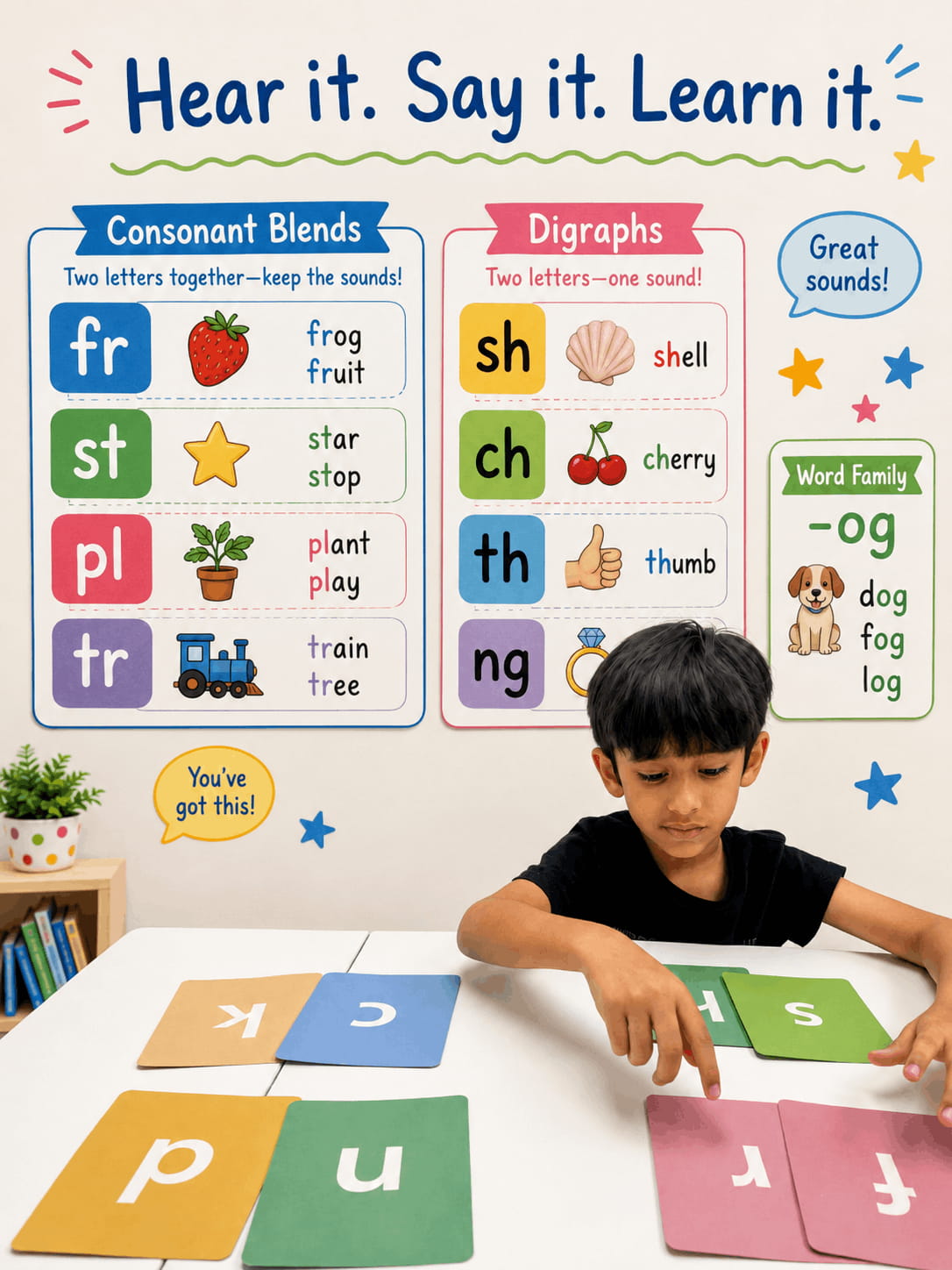
phonics and reading programme for N2 K1 and K2 singapore

What If My Child Is Not Reading at the Expected Level Yet?

Children develop at different rates. Some children begin blending very quickly while others require significantly more repetition before the process becomes automatic. Some can read individual words but struggle with sentences. Others can read aloud beautifully but have difficulty answering questions about what they have read.

This is why our teaching is developmentally progressive rather than simply age-driven.

Our programme provides different levels of:

  • word complexity
  • reading material
  • prompting
  • repetition
  • vocabulary
  • comprehension questioning
  • independent challenge

The objective is to move every child forward from their current stage while continuing to work towards the literacy milestones appropriate for their level.

We Teach Children Strategies — Not Just Answers

Independent readers need strategies.

We teach children to ask:

  • What sound does this letter make?
  • Can I see a sound pattern I already know?
  • Can I break the word into smaller parts?
  • Can I blend those parts together?
  • Does the word make sense in this sentence?

Over time, these strategies reduce a child’s dependence on adults and strengthen their ability to problem-solve while reading.

Phonics + Fluency + Comprehension

A strong reader needs all three.

Phonics
Can I work out the word?
Children learn the relationship between sounds, letters and spelling patterns.

Fluency
Can I read it smoothly?
Children develop accuracy, automaticity, phrasing, pacing and expression.

Comprehension
Do I understand what I just read?
Children develop vocabulary, understanding, recall, sequencing, prediction and inferencing.

When these three areas develop together, children can begin moving from simply decoding text towards genuinely reading for meaning.

Developing Reading Confidence

Reading confidence matters. A child who becomes anxious every time they encounter an unfamiliar word may begin avoiding reading altogether.
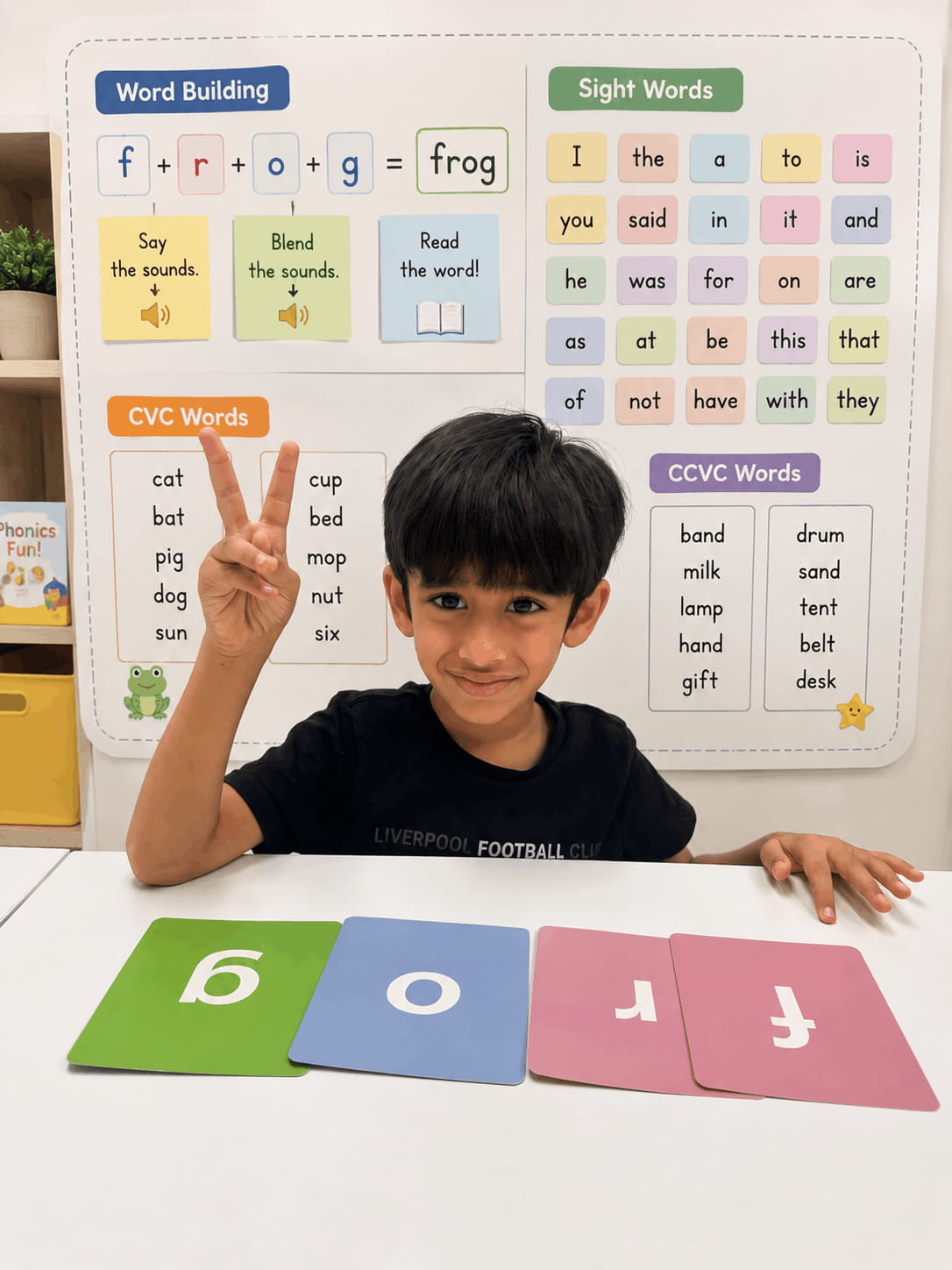
phonics and reading programme singapore

That is why we create opportunities for children to practise reading in a supportive environment where mistakes are treated as part of learning.

Through:

  • guided reading
  • shared reading
  • repeated reading
  • partner activities
  • teacher modelling
  • storytelling
  • reading aloud
  • positive reinforcement

Children gradually become more willing to attempt unfamiliar words and participate independently.

The shift we hope to see is, “I can’t read that!” becoming, “Let me try!”

phonics and reading programme singapore

What Children May Be Exposed To

Across our N2, K1 and K2 phonics classes, children will work on:

  • phonological awareness
  • phonemic awareness
  • letter-sound relationships
  • blending
  • segmenting
  • CVC words
  • consonant blends
  • digraphs
  • word families
  • vowel patterns
  • sight words
  • high-frequency words
  • decoding unfamiliar words
  • spelling through phonics
  • sentence reading
  • decodable texts
  • story reading
  • reading aloud
  • pronunciation
  • reading fluency
  • expression and intonation
  • vocabulary
  • story sequencing
  • reading comprehension
  • prediction
  • simple inferencing
  • sentence construction
  • early writing and dictation
Activities progress as children move through the programme.

Who Is Our Phonics & Reading Programme Suitable For?

Our preschool phonics and reading classes are suitable for:

  • N2 children beginning their phonics journey
  • K1 children learning to blend and decode
  • K2 children preparing for Primary 1

This programme is also suitable for children who may know their letter sounds but still struggle with blending, sentence reading, sight words, fluency, comprehension or reading aloud with confidence.

Our programme supports children who need stronger foundations before Primary 1, as well as confident readers who are ready to progress to more challenging texts.

Children are supported according to their current literacy ability, developmental stage and readiness.

Our Goal

Our programme progressively builds the phonics, fluency, comprehension and confidence children need to become capable readers — ready to understand, learn and thrive as they move towards Primary 1 and beyond.

Register today!

Click here for our primary and secondary programmes!