♥ K1 & K2 Creative Writing Class in Singapore ♥
Creative Writing for Preschoolers —
Building Strong Foundations for Primary 1 Composition Writing
Looking for a K1 or K2 creative writing class in Singapore that will make a difference?
Our K1 & K2 Creative Writing Programme helps preschoolers develop the thinking, language and writing skills they will eventually need for Primary School English and composition writing.
Our K1 & K2 Creative Writing Programme helps preschoolers develop the thinking, language and writing skills they will eventually need for Primary School English and composition writing.
While K1 and K2 children learn through the same core story concepts and creative writing themes, the level of teacher support, vocabulary, sentence construction and independent writing is differentiated according to each child’s age and readiness. This allows both levels to learn together while still being appropriately supported and challenged.
Through age-appropriate story writing, vocabulary development, sentence construction, grammar, story planning and guided creative writing, children learn how to:
- generate their own ideas
- organise their thoughts
- sequence events logically
- build complete sentences
- expand their vocabulary
- develop a simple storyline
- express ideas clearly in writing
For our K2 children, these skills also provide an important bridge towards Primary 1 English and Composition Writing.
Our aim is not to push preschoolers into Primary School composition too early. Instead, we build the foundations of good writing so that when more formal writing is introduced, children already understand how to think, plan and express their ideas.
Why Start Creative Writing in K1 & K2?
Many parents focus on reading and phonics during the preschool years — and rightly so.
However, being able to read does not automatically mean that a child knows how to write independently.
When children are eventually asked to produce their own writing, they need a very different set of skills. They need to know:
- What should I write about?
- How do I start my story?
- What happens next?
- How do I put my idea into a sentence?
- How can I make my sentence more interesting?
- How should my story end?
For many young children, the challenge is not a lack of imagination. The challenge is learning how to organise that imagination and translate it onto paper.
Our preschool creative writing programme begins developing this process early through teacher modelling, storytelling, picture prompts, discussion, vocabulary building, story planning and guided writing.
Preparing Children for Primary 1 English
Our K1 and K2 Creative Writing Programme in Singapore is designed with the progression into the MOE Primary English syllabus in mind.
As children progress through primary school, they are expected to become increasingly capable of generating, selecting, organising, developing and expressing ideas in writing.
We introduce the foundations of these writing processes while children are still in preschool — but at a level that is developmentally appropriate.
- Children learn to generate ideas.
- Children explore pictures, characters, situations and story prompts and are encouraged to think beyond the most obvious answer.
- Instead of simply asking, “What can you see?” we may encourage them to think:
“What could have happened before this?”
“Why is the character feeling this way?”
“What could happen next?”
This strengthens both creative thinking and composition idea generation.
In our programme:
1. Children Learn to Sequence Ideas
Good composition writing requires ideas to follow in a logical order.
Children learn to recognise:
Beginning → Middle → Ending
and gradually understand that events in a story should connect rather than appear as unrelated sentences.
2. Children Learn to Plan a Story
Rather than expecting children to immediately write a story from a blank page, we teach them how to organise their thoughts first.
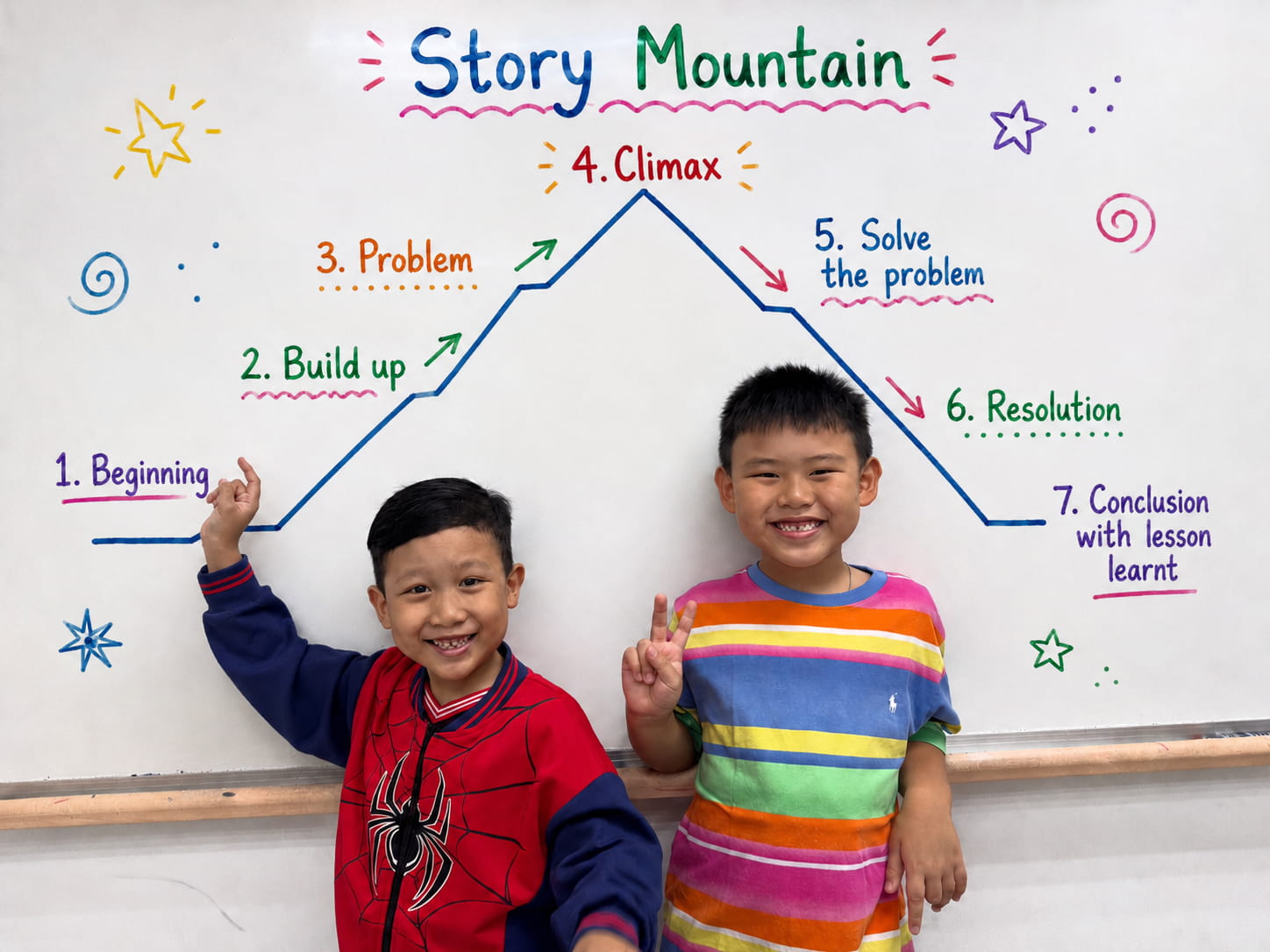
Children may use simple writing frameworks such as a Story Mountain to identify:
- Characters
- Setting
- Beginning
- Problem
- Important events
- Solution
- Ending
Story planning gives young writers a structure they can follow and gradually develops the habit of thinking before writing.
3. Children Learn to Develop Their Ideas
One of the biggest differences between basic writing and stronger composition writing is elaboration.
A child may initially write:
The boy was scared.
We begin encouraging them to think further:
Why was he scared?
What did he see?
What did he do?
How did his body react?
What happened because of it?
Children gradually learn that writing becomes more interesting when they develop an idea instead of simply stating it.
4. Children Build Stronger Sentences
Creative writing also gives children an opportunity to apply important English language skills in context.
Depending on their level, we work on:
- complete sentence construction
- capital letters and full stops
- appropriate grammar
- nouns, verbs and adjectives
- sentence expansion
- conjunctions
- spelling awareness
- punctuation
- descriptive vocabulary
Instead of learning grammar only as an isolated worksheet exercise, children begin seeing how language works within their own writing.
5. Vocabulary for Creative Writing
One common concern Singapore parents have is:
“My child knows what happened, but doesn’t have the words to describe it.” Vocabulary therefore forms an important part of our creative writing lessons.
Children are exposed to useful age-appropriate vocabulary such as:
- Stronger Action Words
Instead of always using walked, children may gradually encounter words such as:
strolled, marched, rushed, crept or tiptoed. - Emotions
Children learn to move beyond simply using:
happy, sad, angry and scared.
They develop a wider emotional vocabulary and learn how a character’s feelings can be shown through their actions. - Descriptive Language
Children learn words and phrases to describe people, places, weather, objects, sounds, movements, feelings
The objective is not to memorise complicated vocabulary.
It is to help children build a usable vocabulary bank that they understand and can confidently apply in their own writing.
One Creative Writing Programme for Both K1 & K2
K1 and K2 children can benefit from learning within the same programme because they are developing the same fundamental writing processes.
However, the level of writing, vocabulary, independence and teacher support is differentiated according to each child’s age and readiness.
This means that children may work from the same creative writing theme or picture stimulus, while completing very different levels of work.
One of the strengths of our combined K1 and K2 creative writing class is differentiation.
For example, imagine the children are given a picture of a boy discovering a mysterious box.
A K1 Child May Be Guided To:
- identify the character
- describe the box
- suggest what may be inside
- sequence what happened
- write 2–4 clear sentences with support
A K2 Child May Be Challenged To:
- decide where the character found the box
- develop a reason for discovering it
- plan what was inside
- create a problem or surprise
- describe the character’s reaction
- develop the events that followed
- create an appropriate ending
- write a longer sequence of connected sentences
Same stimulus. Same class. Different level of challenge.
This allows both K1 and K2 children to develop within the same programme while being appropriately supported and challenged according to their writing ability.
Building the Foundations for Primary School Composition Writing
Composition writing becomes increasingly demanding as children progress through primary school. Our objective is therefore not to make K1 and K2 children memorise Primary School model compositions. Instead, we teach the foundations that make composition writing more manageable later.
Helping Children Move Beyond “I Don’t Know What to Write”
One of the most common difficulties children experience in composition writing is not necessarily spelling or handwriting. It is the blank page.
A child may stare at a picture and say, “I don’t know.”
That is why we explicitly teach idea generation. Children learn that when they do not immediately know what to write, there are strategies they can use.
Over time, our goal is for children to move from,
“I don’t know what to write.”
to:
“I have an idea. I know how to start.”
Creative Writing Supports More Than Composition
Creative writing is not only useful for future composition writing. It strengthens several areas of a child’s English development.
- Reading Comprehension
When children understand characters, settings, problems, solutions, sequencing and cause and effect in their own stories, they become better equipped to recognise the same elements when reading. - Grammar
Writing gives children an authentic opportunity to apply grammar rather than only identifying correct answers in worksheets. - Vocabulary
Children gradually develop a broader bank of words and phrases that can support both spoken and written English. - Verbal Expression
Children practise explaining their thoughts clearly before transferring those ideas into writing. - Critical Thinking
Children make choices about characters, problems, consequences and solutions. - Creativity
Children discover that there can be many possible stories from the same picture or prompt. - Confidence
Most importantly, children gain confidence in seeing themselves as capable writers.
Why This Class Can Help Before Primary 1
A child may be able to read fluently and spell many words yet still struggle when asked to create something independently.
Creative writing helps bridge that gap.
By teaching children a repeatable process for:
Generating Ideas → Organising Ideas → Building Sentences → Developing a Story → Reviewing Their Writing
we give them a framework they can continue drawing upon as writing tasks become more challenging.
For K2 children in particular, this provides a meaningful bridge between preschool literacy and Primary 1 English.
We Don’t Just Teach Children What to Write. We Teach Them How to Think.
Who Is This Creative Writing Programme Suitable For?
Our K1 & K2 Creative Writing Programme in Singapore is suitable for:
- K1 children beginning to explore independent writing
- K2 children preparing for Primary 1
- children who have lots of ideas but struggle to put them on paper
- children who write very short sentences
- children who need support with story sequencing
- children who need to build vocabulary
- children who lack confidence when asked to write independently
- children who enjoy storytelling and want to develop their writing further
No previous creative writing class experience is required!
Our Goal
To take children from having ideas in their heads to confidently organising and expressing those ideas on paper.
Give your child a strong foundation in creative writing, English composition, vocabulary, sentence construction and story planning, while developing the confidence to approach writing independently.
K1 & K2 Creative Writing Programme Singapore

LoveKids Serangoon Gardens
24A Maju Avenue
Singapore 556696
LoveKids Yishun
417 Yishun Avenue 11 #01-321
Singapore 760417
REGISTRATION
ABOUT US
SPECIALIZED PROGRAMMES
Specialised Speech and Drama Programme for Infants
( *Only at LK Yishun* )
Specialised Speech and Drama Programme for Toddlers, Playgroup, N1
Speech and Drama with Public Speaking for Nursery
Phonics and Reading Programme for N2, K1 & K2NEW!
Speech and Drama with Public Speaking for K1
Creative Writing Programme for K1 & K2NEW!
Specialised One-on-One Learning Support Classes for Preschool
Confidence for PSLE English for P5