K1 Phonics and Reading Programme
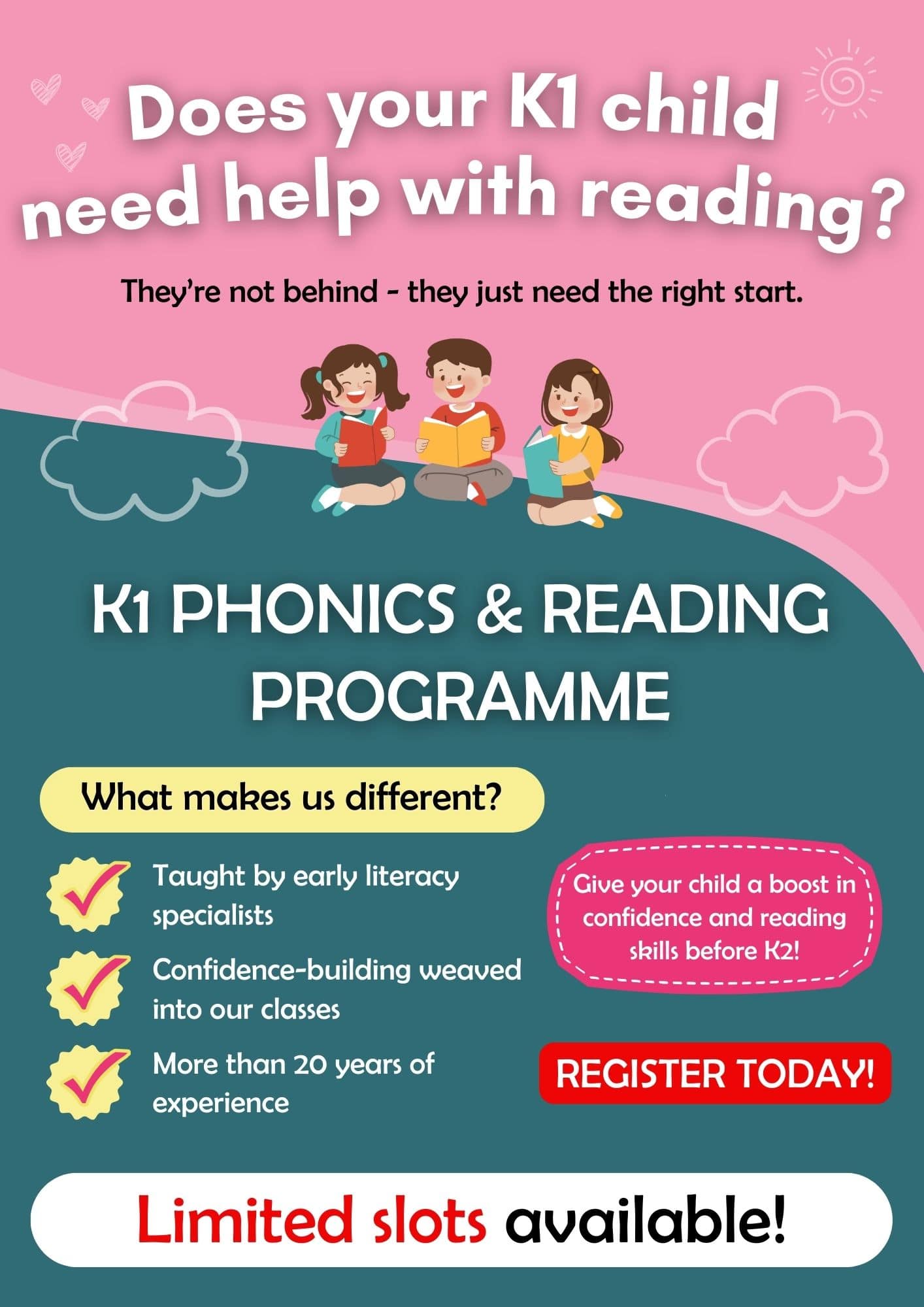
Your child isn’t behind – they just need the right start.
Speech ♥ Drama ♥ EQ
K1 Phonics and Reading Programme For 5-Year-Olds
Structured Reading & Phonics Classes Designed for Kids Who Need That Extra Boost
If your K1 child is still struggling to read or blend words, don’t panic. Our Phonics and Reading Programme (Special Edition) is your child’s chance to build real reading skills before K2, in just 18 powerful sessions this August to Early December.
This is a limited-time programme, specially designed for parents who know that reading doesn’t just “click” for every child – and want to help their child catch up, feel confident and love reading.
This is a limited-time programme, specially designed for parents who know that reading doesn’t just “click” for every child – and want to help their child catch up, feel confident and love reading.
What Makes This Programme Different?
📚 Structured phonics and blending instruction based on the Science of Reading
✨ Designed for children who know their letter sounds but aren’t yet fluent readers
🧠 Small-group sessions focused on real results
💛 A confidence-building reading journey that sets your child up for K2 readiness
🍎 Incorporates drama and confidence-building strategies into every lesson to make learning engaging and effective
What Your Child Will Learn
Our special edition programme is divided into four purposeful terms to support your child’s reading journey:
Term 1: Building Strong Foundations in Early Literacy
In Term 1, children develop the essential foundations needed for confident reading. We focus on strengthening listening skills, sound awareness and core phonological abilities such as sound discrimination, onset-rime recognition and early syllable awareness through rich multisensory activities.
Children are introduced to key pre-reading skills within a structured literacy approach, learning to map sounds to meaning, respond to auditory cues, and develop early print awareness – including tracking print directionally, distinguishing words from pictures, and understanding basic book-handling conventions. Alongside language skills, we place strong emphasis on EQ development: turn-taking, active listening, cooperative play, and building the emotional confidence to participate without fear of making mistakes.
This term lays the groundwork for joyful engagement with stories while nurturing a secure, confident learner.
Term 2: Developing Phonics Skills, Early Blending & Reading Readiness
Building on the strong foundations laid in Term 1, Term 2 introduces children to early phonics application in a structured way. They begin applying their phonological awareness to early decoding, learning to blend and segment CVC patterns using systematic phonics techniques.
Children explore foundational word families to strengthen onset–rime fluency and begin recognising spelling patterns that support orthographic development. High-frequency sight words are introduced gradually to build automaticity and reduce cognitive load during reading.
Through dramatisation, story-based tasks and multisensory blending activities, children practise forming simple words, identifying recurring linguistic patterns and reading short, predictable sentences with teacher scaffolding. EQ skills continue to be intentionally strengthened and children learn to persevere through trickier blends, celebrate small reading wins! They also gain the confidence to read aloud in a supportive environment.
This term nurtures early reading fluency, vocabulary growth and expressive reading habits while steadily growing each child’s belief in their own abilities.
Term 3: Applying Skills, Strengthening Fluency & Understanding Stories
In Term 3, children begin applying their phonics knowledge to authentic reading tasks with increasing independence. They draw confidently from multiple decoding strategies: phoneme–grapheme correspondence, emerging orthographic mapping, high-frequency sight word recall and simple contextual inference. This helps them to read longer phrases and early sentences.
Lessons place stronger emphasis on developing reading fluency, intonation, phrasing and expressive delivery, helping children move beyond mechanical decoding toward meaningful, connected reading.
Through guided comprehension activities, picture sequencing and story-structure exposure, children learn to interpret text, predict events and grasp simple narrative flow. Drama-based learning, role-play and guided presentations deepen comprehension by encouraging children to embody characters and express meaning with voice, gesture and facial expression.
Throughout the term, EQ and communication skills remain central – children practise taking turns as readers, building courage to read and present aloud. This stage transforms early readers into expressive, confident young readers who understand what they read, not just how to read it.
Term 4: Mastery, Confidence & Independent Reading Skills for K2 Readiness
In Term 4, children consolidate their learning and move toward greater reading independence and confidence. With a strong phonics base already established, they refine decoding accuracy, strengthen orthographic mapping and apply a wider range of high-frequency sight words to read longer, more complex sentences.
Greater focus is placed on reading fluency – intonation, pausing, phrasing and expressive modulation – so children learn to read not only correctly but meaningfully. Comprehension tasks expand to include simple inferencing, identifying key ideas, and using punctuation cues to guide expressive reading.
Children also begin constructing their own short written sentences, strengthening the connection between encoding (spelling) and decoding (reading). Drama integration and structured presentation opportunities encourage them to articulate clearly, speak with confidence and express ideas with growing emotional awareness and empathy.
By the end of Term 4, children demonstrate stronger independence, clearer vocal expression, and heightened self-belief, emerging as confident, capable young readers fully prepared for the expectations of K2.
Assessment & Progress Checklist
We follow a developmentally appropriate and evidence-based progression based on the Science of Reading:
✅ Each child will be informally assessed on:
| Skill Area | Targets by End of Each Term |
|---|---|
| Phonemic Awareness | Identify beginning/middle/end sounds (Term 3), segment and blend 3-sound words (Term 4) |
| Phonics | Recognise and apply letter-sound correspondences and digraphs |
| Decoding | Blend CVC words (Term 3), read decodable sentences with accuracy (Term 4) |
| Sight Word Recognition | 5 – 8 words (Term 3), 10 – 15 words with fluency (Term 4) |
| Reading Fluency | Slow, accurate reading with support (Term 3); improved speed and expression (Term 4) |
| Comprehension | Match text to pictures, answer simple who/what/where questions (Term 4) |
| Writing | Spell simple CVC words (Term 3), write 4–6 word sentences using phonics and punctuation (Term 4) |
| Oral Reading Confidence | Participate in group reading (Term 3), read aloud independently to a teacher/peer (Term 4) |
Each child receives personalised feedback and a Reading Progress Sheet at the end of each term, giving parents clear insight into strengths, areas for growth and K2 readiness.
Class Details
📍 Locations: Serangoon Gardens & Yishun
👧👦 Small Group Setting (max 8 children per class)
⏰ 1 hour 15 mins per week (starting early August 2025)
🧑🏫 Taught by expert early literacy specialists
Don’t Miss Out
This is a one-time programme for 2025 — and spaces are limited.
If your child has been struggling to read or blend confidently, this could be the turning point before K2!
Register today!


LoveKids Serangoon Gardens
24A Maju Avenue
Singapore 556696
LoveKids Yishun
417 Yishun Avenue 11 #01-321
Singapore 760417
REGISTRATION
ABOUT US
SPECIALIZED PROGRAMMES
Specialised Speech and Drama Programme for Infants
( *Only at LK Yishun* )
Specialised Speech and Drama Programme For Toddlers, Playgroup, N1
Speech and Drama with Public Speaking for Nursery
Speech and Drama with Public Speaking for K1
K1 Phonics and Reading Programme
Specialised One-on-One Learning Support Classes for Preschool
Confidence for PSLE English for P5